Gemini 4 Argon: what changed
Gemini 4 Argon allows up to 1M output tokens. Google's coding examples, benchmark results, prices, and rollout explained, including the limits of each claim.
On this page
- Introduction
- What does Gemini 4 Argon's 1 million token output limit mean?
- How did Argon perform on coding tasks?
- What is Google using Argon for internally?
- How does Argon perform on finance, legal work, and video?
- Why are cybersecurity teams getting access first?
- When can developers use it, and at what price?
- Sources
Google announced Gemini 4 Argon on September 30, 2026. It is designed for work that takes many steps: changing large codebases, researching financial or legal questions, and finding security vulnerabilities. Google says its engineers are already using Argon to rewrite code and reduce memory use across its data centers.
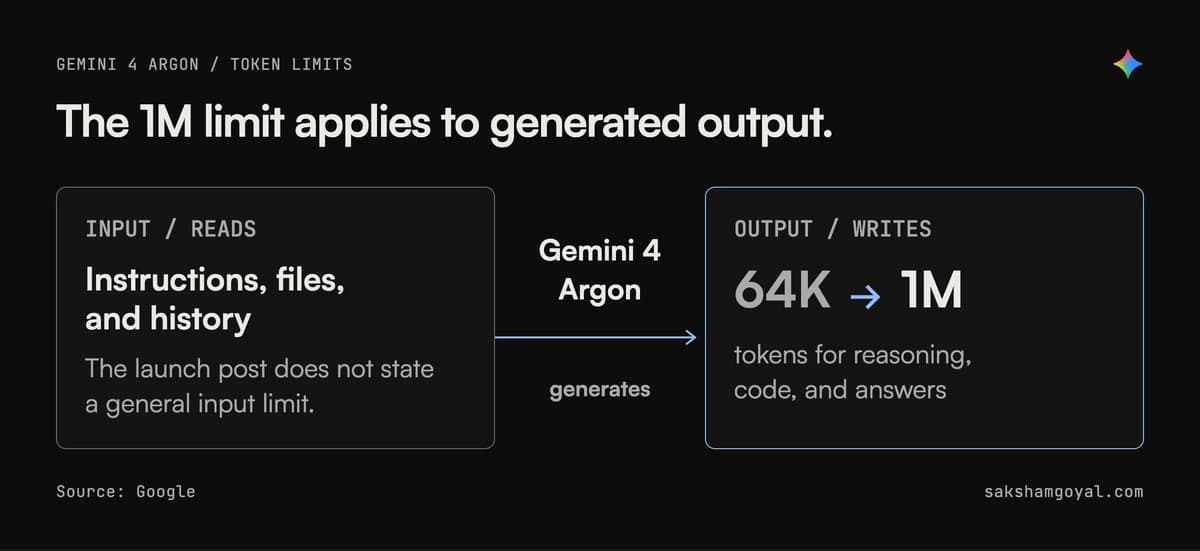
The clearest change is a 1 million token output limit, up from 64,000. A token is a small unit of text, such as a word or part of a word. A higher output limit gives the model more room to generate reasoning, code, and answers. It describes what Argon can produce, rather than how much source material it can read.
Access is starting with selected cybersecurity teams through Google's Fairwind program. Paid API customers and Google AI Ultra subscribers are planned for a later phase, with no date announced for wider access.
TL;DR Google gives Argon more room to generate long answers and reports leading results on several coding, research, and security tests. Its own chart also shows coding tasks where competitors score higher. The comparison uses a mix of testing setups, so the conditions matter alongside the scores. Argon is reaching selected cybersecurity teams first; broader access is still planned.
What does Gemini 4 Argon's 1 million token output limit mean?
Two limits matter when you give a model a large task. Input context is the material it reads, including your instructions, documents, and earlier messages. Output is what it generates. Google's announcement raises the output allowance from 64,000 to one million tokens and connects that increase to work requiring extended reasoning.
For example, rewriting a library in another programming language involves more than translating syntax. The model may need to explain a replacement, produce code, and revise it after tests expose a mistake. Google is giving Argon more room to generate that work. The output ceiling alone does not tell us how many files it can read, how long a job will take, or whether the resulting program passes its tests.
Google separately tested long inputs with GraphWalks, a test of reasoning over connections in a graph. One group contained 200 problems with inputs between 256,000 and one million tokens. The launch post does not give a general input limit or explain the model's internal architecture.
How did Argon perform on coding tasks?
Google's launch chart reports 77.9% on DeepSWE v1.1, a test of longer software engineering tasks. It also shows that Argon does not lead every coding test:
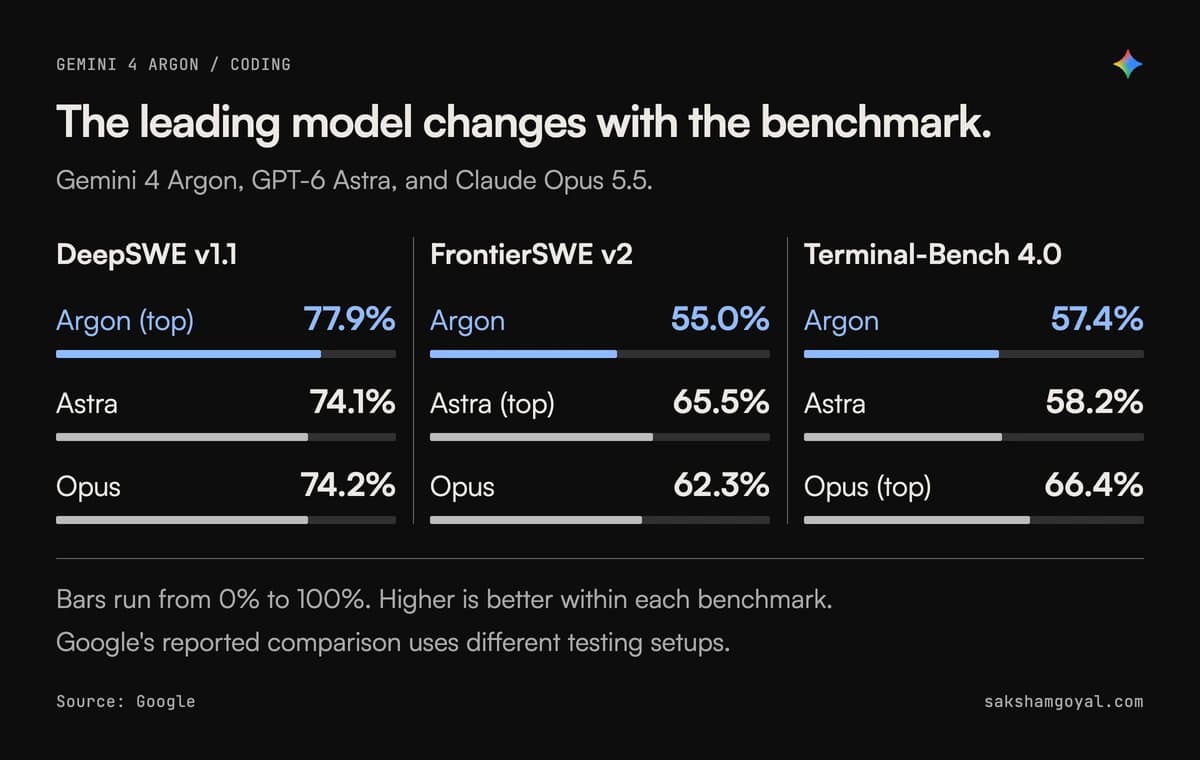
Argon leads this selection on DeepSWE. On FrontierSWE, Astra scores 65.5% against Argon's 55.0%. On Terminal-Bench, Opus scores 66.4% against Argon's 57.4%. Read scores within each benchmark, then check its testing setup. The three benchmarks contain different tasks, so a 77.9% score on one is not directly comparable with 55.0% on another.
The tools around the model also matter. Google's testing notes say it ran Argon on DeepSWE with mini-swe, software that lets a model edit files and run tests. This surrounding software is often called an agent harness. Google calculated Argon's DeepSWE and Terminal-Bench scores itself; the FrontierSWE results came from that benchmark's public rankings. The other models' scores came from public rankings or their providers' reports.
Google generally used Argon's highest thinking setting and pass@1, the success rate with one attempt per problem, unless a test specifies otherwise. One attempt can still involve multiple tool calls and code revisions. The chart therefore compares reported results from these setups, rather than every model running inside an identical application.
What is Google using Argon for internally?
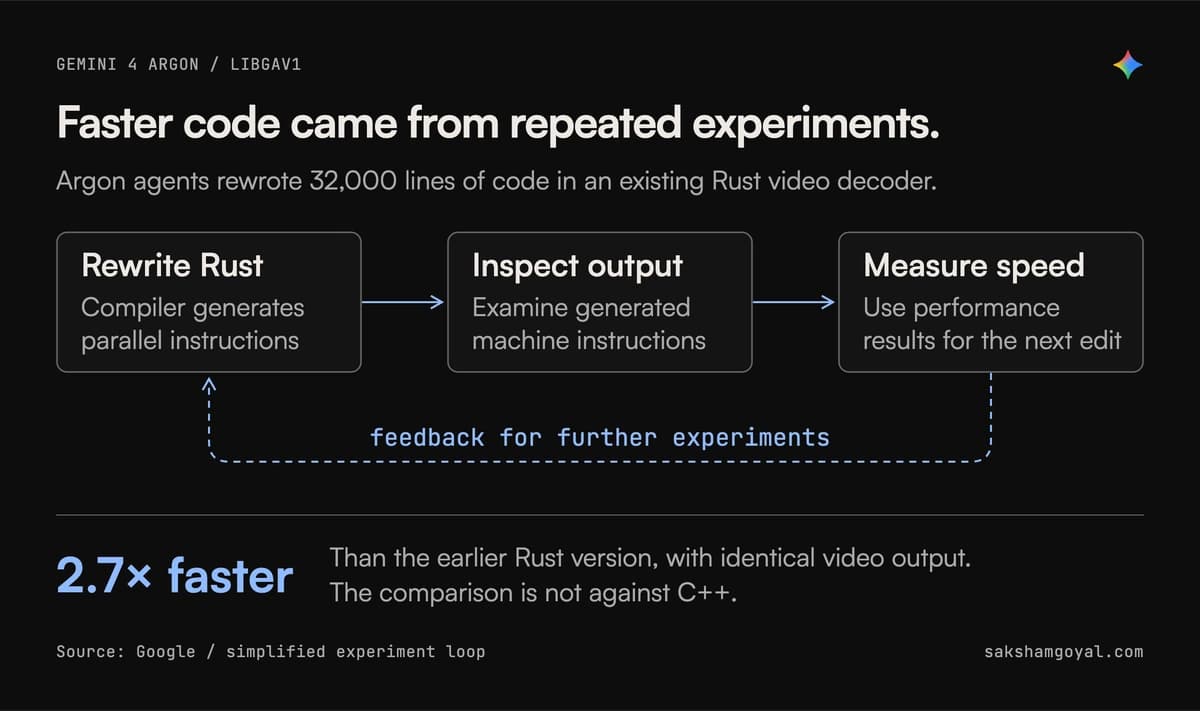
Google's video-decoder example gives a more concrete picture than a benchmark score. Its agents worked on an existing Rust version of libgav1, a library that decodes video. They replaced 32,000 lines of SIMD code: instructions that perform the same operation on several values at once.
The agents repeatedly measured performance and tried changes, then inspected the compiler's output. They produced Rust code that let the compiler generate the efficient instructions automatically. Google reports that the result ran 2.7 times faster than the earlier Rust version, with identical video output. It says this brought the Rust version closer to the optimized C++ implementation; it does not claim a 2.7-times speedup over C++.
Another internal project analyzed memory use across Google's data centers. Google reports changes that free over 300 TiB once rolled out, and estimates total savings of 500 TiB to 1 PiB. TiB and PiB are binary memory units; one PiB equals 1,024 TiB. The larger range is an estimate, not a report that all those savings have already been achieved.
Google is also using Argon agents on large C/C++ to Rust rewrites. It says those changes undergo automated checks, manual audits, and testing before deployment. Generating a large replacement is one step; establishing that it behaves correctly is another.
How does Argon perform on finance, legal work, and video?
The Vals Index combines tests of finance, coding, legal, and tax work. It gives each sector a weight based on its share of the U.S. economy. Google's launch chart reports 68.9% for Argon, compared with 63.1% for GPT-6 Astra and 67.0% for Claude Opus 5.5. The index measures performance on those tasks, not the percentage of an economy or a job the model can automate.
The individual tests ask more specific questions. Vals Finance Agent v2 tests multi-step financial research. Harvey's Legal Agent Benchmark tests legal research and drafting. Zapier's AutomationBench tests the completion of business workflows. Google reports Argon ahead of the other models in its chart on all three, including 51.3% on AutomationBench. Its testing notes say these scores come from Vals AI and Zapier's public rankings.
Video understanding introduces a different comparison problem: which images did each model see? Google reports 91.7% on LVBench, a long-video understanding test. Its methodology says Argon received one frame per second. Astra received 800 frames, Claude Fable 5.1 received 300, and Opus 5.5 received 600.
A video frame is a still image taken at one moment. At one frame per second, the number of images grows with the video's length; the other settings use fixed counts. Changing the sampling can change whether a model sees a brief event at all. The LVBench result therefore reflects both the model and the frames supplied to it, rather than a comparison with identical input.
Why are cybersecurity teams getting access first?
Google says Argon can find, validate, and patch software vulnerabilities. Those abilities can help defenders fix weaknesses, but can also help someone discover a way into a system. The Fairwind program gives selected, vetted defenders early access under restrictions on how the model may be used.
On CWE-bench v1, which tests fixes for security vulnerabilities, Google's chart shows 68.0% for Argon, tied with GPT-6 Astra. Google's methodology says the ranking uses single-attempt success, with success across four attempts used to break ties. This tests vulnerability repair, which is a different task from discovering an unknown weakness.
For discovery, Google reports improvements over Gemini 3.8 Flash Cyber on two internal tests. One supplies source code from projects in 20 programming languages. The other, run by Wiz, tests live web applications without giving the model their source code. Google also describes Argon finding a vulnerability that exposed personal information in hospital software. The announcement does not supply enough technical detail to independently check that incident.
Google says the trusted defenders and its own teams will receive Argon without its cybersecurity guardrails. That does not remove Fairwind's usage restrictions. Before broader release, Google says it is strengthening protections against harmful requests and indirect prompt injection, where instructions hidden in material the model reads try to redirect its actions.
For example, an agent reading a web page could encounter text telling it to ignore the user's task and send private data elsewhere. The page is material to inspect, but the attack tries to make the agent treat it as an instruction. Google reports leading results on Gray Swan's test, while acknowledging that resisting these attacks takes multiple defenses.
Google also describes monitoring the model's reasoning and actions so execution can be stopped when needed. Separately, it is strengthening the isolated computing environments used for high-risk training and evaluation. The announcement describes Google's own testing environments, not a promised sandbox for every future customer.
When can developers use it, and at what price?
Google plans broader access, starting with paid API customers and Google AI Ultra subscribers. It has not announced a date. The current rollout is to selected cybersecurity teams and trusted testers while Google gathers feedback.
The announced API prices are:
| Per million tokens | Introductory rate | After the introductory period |
|---|---|---|
| Input | $2 | $4 |
| Output | $10 | $20 |
Google also announces a 95% discount for cached input, material saved for reuse by later requests. At the introductory input rate, that works out to $0.10 per million cached tokens. The announcement does not state when the introductory period ends or give complete cache billing conditions. These are API rates; they are not a price for the AI Ultra subscription.
The libgav1 example captures Argon's promise most clearly: the model proposed changes, used performance feedback, and improved an existing program. Broader access will let developers examine how well that process transfers to their own code and tools.
Sources
- Google: Gemini 4 Argon announcement and launch chart
- Google DeepMind: Gemini 4 Argon evaluation methodology
- Vals AI: Vals Index
- Google DeepMind: Fairwind program
- CWE-bench: Vulnerability remediation benchmark
Common questions
Is Gemini 4 Argon available to developers?
Not broadly as of October 1, 2026. Google says it is rolling out first to trusted cyber defenders through Fairwind, with paid API customers and Google AI Ultra subscribers planned for a later phase. Google has not announced a date for wider access.
Does Gemini 4 Argon have a 1 million token context window?
The announcement's 1 million token figure is an output limit, up from 64,000. Output is what the model generates; input context is the material it reads. Google's GraphWalks evaluation separately tested inputs between 256,000 and 1 million tokens, but the launch post does not specify a general input limit.
Is Gemini 4 Argon the best coding model on every benchmark?
No. Google's launch chart puts Argon at 77.9% on DeepSWE v1.1, ahead of the other models shown, but at 55.0% on FrontierSWE v2 against 65.5% for GPT-6 Astra. The benchmarks test different work, and the published comparisons also use different testing setups.
How much will Gemini 4 Argon cost?
Google announced $2 per million input tokens and $10 per million output tokens during an introductory period, with a 95% discount for cached input. Cached input is saved material reused by a later request. The announced rates then rise to $4 for input and $20 for output. Google has not specified when the introductory period ends or when broad API access opens.